

⚡ TL;DR — Survival Shelter in 60 Seconds
Shelter is your first survival precedence — not water, not meals. Publicity kills in hours. The Rule of Threes says you’ve got three hours in harsh climate with out shelter earlier than hypothermia turns into life-threatening.
There are two classes: primitive shelters constructed from pure supplies (Lean-To, Particles Hut, A-Body) and fashionable configurations utilizing a tarp or poncho. Figuring out each doubles your survival choices.
The gear picks on the backside of this information cowl the 4 objects that stretch each shelter’s effectiveness — tarp, paracord, folding noticed, and emergency bivvy. All verified Amazon listings.
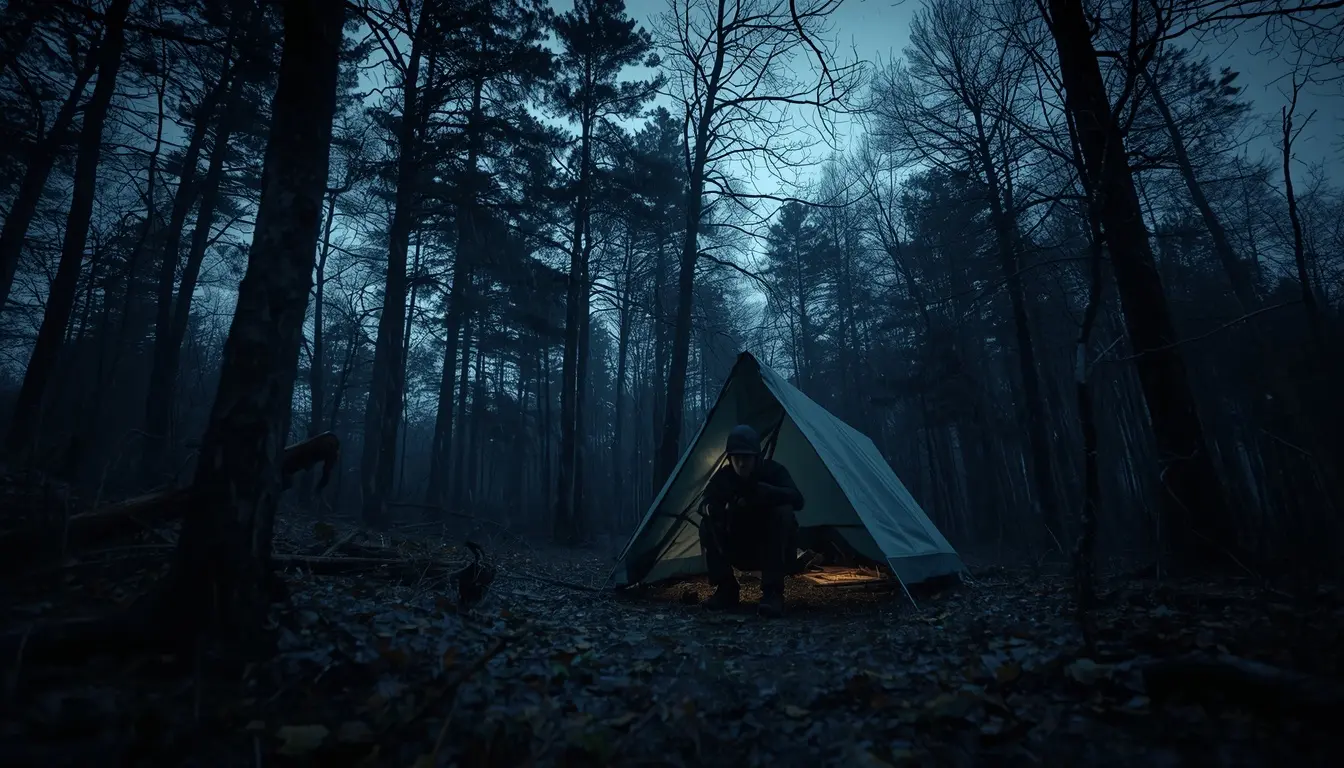
A survival shelter is your single most vital precedence the second you understand you might be spending an unplanned night time open air. Not fireplace. Not water. Not meals.
The Rule of Threes makes this clear: an individual can survive three minutes with out air, three hours with out shelter in harsh situations, three days with out water, and three weeks with out meals. Publicity strikes to the highest of the kill record the second temperature and moisture mix in opposition to you.
In Northern Michigan, that window isn’t a theoretical quantity.
Alongside the Pere Marquette River hall in late September, in a single day temperatures drop into the low 40s with excessive humidity. Wind off Lake Michigan drops the efficient temperature additional. A moist hiker in 45°F air with a 15mph wind is in real hazard inside two hours with out shelter.
Hypothermia doesn’t require freezing temperatures. It requires your core temperature to fall under 95°F — which moist clothes, wind, and exhaustion can accomplish in climate most individuals would name “cool, not chilly.”
⚠️ The Rule of Threes — Survival Precedence Order
• 3 minutes with out air (or in icy water)
• 3 hours with out shelter in harsh climate
• 3 days with out water
• 3 weeks with out meals
Two forms of warmth loss kill within the discipline: convective (wind stripping heat out of your pores and skin) and conductive (chilly floor pulling warmth instantly out of your physique).
A superb survival shelter addresses each. A roof stops convective loss. Floor insulation — addressed in Part 06 — stops conductive loss. Miss both one and the shelter is barely half an answer.
And earlier than you construct something, be certain somebody is aware of the place you might be. Our Garmin inReach Mini 2 vs Mini 3 satellite tv for pc communicator comparability covers the two-way emergency signaling layer that will get rescue shifting whereas your shelter retains you alive.
3hrsTime earlier than shelterbecomes vital
95°FCore temp thresholdfor hypothermia
5Primitive shelterbuilds on this information
2Warmth loss typesyour shelter should cease
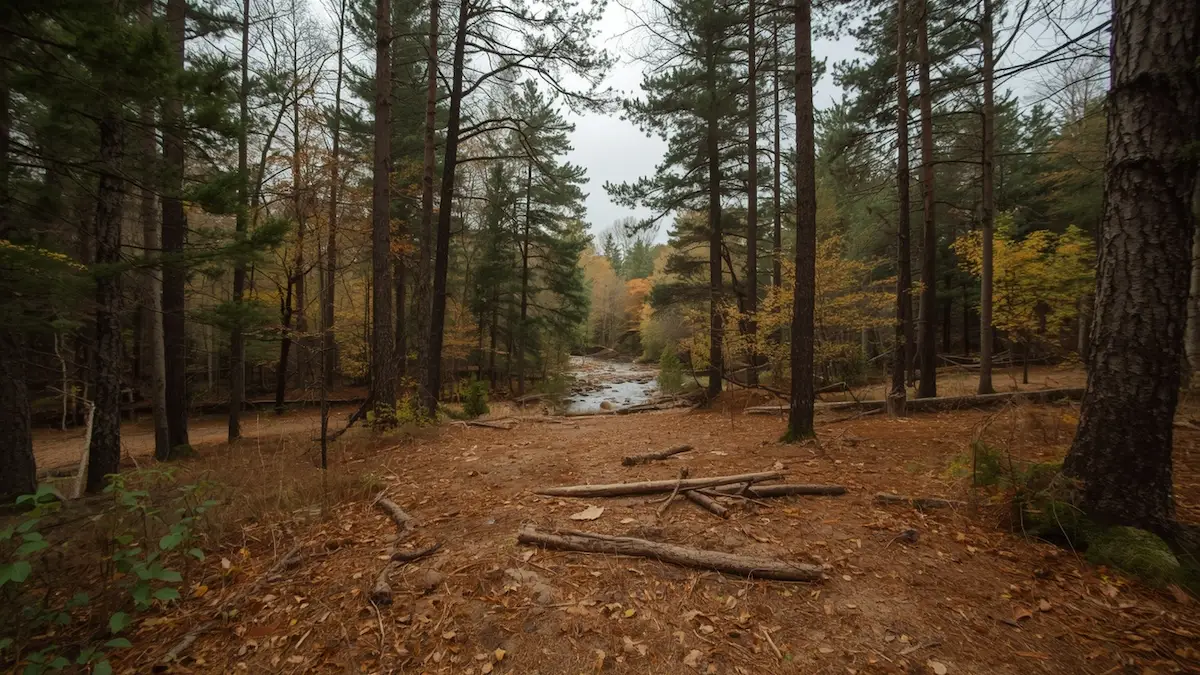
The place you construct issues as a lot as what you construct. An ideal lean-to in a flood plain or on the base of a lifeless tree is a legal responsibility, not an asset.
Use the 5 Ws framework earlier than you decide to a location. For a broader camp setup guidelines, our deer camp gear and necessities guidelines covers the total in a single day backcountry package.
THE 5 Ws OF SITE SELECTION
🪵 Wooden — Is sufficient constructing materials inside 50 toes? Hauling logs 200 yards burns energy you can not afford.
💧 Water — Are you close to a water supply? Shut sufficient to entry, however not so shut you might be in a flood zone or insect swarm zone.
🌲 Widowmakers — Lookup. Useless branches, leaning timber, and widow-maker snags can come down in wind or below snow load. By no means shelter below one.
🌬️ Climate — Which path is the wind coming from? Orient your shelter opening away from prevailing wind. Test for low-lying areas the place chilly air swimming pools in a single day.
🐜 Wigglies — Keep away from ant hills, wasp nests, recreation trails, and standing water that draws biting bugs. Test the bottom earlier than you commit.
Elevation issues greater than most rookies understand.
Chilly air is denser than heat air and flows downhill like water. The valley flooring that appears sheltered from wind is commonly 5–8°F colder than a hillside place 30 toes larger.
Within the Manistee Nationwide Forest, that temperature differential between a valley backside and a mid-slope place might be the distinction between a manageable night time and a harmful one.
Orient your shelter door away from prevailing wind.
In Northern Michigan, prevailing winds come predominantly from the southwest in summer time and northwest in winter. A shelter opening dealing with northeast takes full benefit of pure wind safety in each seasons.
Lastly — hold your shelter small. A shelter sized simply massive sufficient to your physique retains warmth from your individual heat much more successfully than one with additional headroom. Each cubic foot of lifeless air area you warmth is power your physique loses.
These 5 builds require nothing out of your pack — solely what the forest supplies. Every has a special effort-to-reward ratio. Know all 5 so you possibly can match the construct to your power stage and accessible supplies.
🪵 1. Lean-To Best Construct
The lean-to is the quickest primitive shelter you possibly can construct. One sloped wall deflects wind and rain. Not absolutely enclosed, so it depends on a hearth in entrance for warmth — however when time and power are brief, it’s the proper name.
Finest for: Gentle situations, brief in a single day stays, when fireplace is feasible.
Discover two timber roughly 8 toes aside. Lash a horizontal ridge pole between them at chest top utilizing paracord or pure cordage.
Lean branches and sticks at a forty five° angle from the ridge pole all the way down to the bottom to type the again wall.
Layer smaller branches perpendicular throughout the angled poles — working from backside to prime like roof shingles.
Add a thick layer of leaves, bark, or pine boughs over the framework. Goal for 12 inches of layering minimal.
Construct your fireplace 3–4 toes in entrance of the opening. The lean-to again wall displays warmth inward.
🍂 2. Particles Hut Finest Thermal
The particles hut is the warmest primitive shelter on this information — able to maintaining you alive in near-freezing temperatures with no fireplace, no sleeping bag, and no gear. The mass of leaves surrounding your physique insulates like a cocoon.
Finest for: Chilly climate survival, no fireplace doable, most thermal effectivity.
Discover a ridge pole 9–10 toes lengthy. Prop one finish within the fork of a tree or on a stump at waist top, the opposite finish on the bottom.
Lean branches alongside either side of the ridge pole to type an A-frame ribcage construction — shut sufficient that particles gained’t fall by.
Pile leaves, pine needles, and forest particles over the body — minimal 2 toes thick on all sides. The extra the higher.
Fill the inside utterly with dry leaves — you’ll burrow into this pile for insulation from under and above concurrently.
Block the doorway with a pile of leaves or a big department as soon as inside. Your physique warmth warms the inside inside minutes.
⚠️ Air flow notice: The particles hut is a sealed surroundings. Depart a small hole on the entrance or poke a small air gap close to your head to stop CO₂ buildup throughout sleep.
🏕️ 3. A-Body Shelter Finest Balanced Construct
The A-frame is a totally enclosed particles hut variant with two sloped partitions assembly at a central ridge. Extra enclosed than a lean-to, much less labor-intensive than a full particles hut. The precise middle-ground shelter for average situations.
Finest for: Rain, average chilly, multi-night stays.
Prop a protracted ridge pole horizontally between two timber or forked helps at about 4 toes excessive.
Lean branches at 45° angles alongside either side of the ridge pole to type the 2 partitions.
Layer particles and leaves thickly over each partitions — backside to prime, shingle-style.
Construct a particles flooring inside not less than 4 inches deep earlier than sleeping on it.
🏹 4. Wicki-Up (Tipi Body) Finest Wind Safety
A cone-shaped framework of poles lashed on the prime and unfold on the base — the identical structural precept as a tipi. Wrap with bark slabs, massive leaves, pine boughs, or a tarp. Naturally sheds rain and wind from all instructions.
Finest for: Open terrain, all-direction wind publicity, when tarp materials is obtainable.
Lash 4–6 lengthy poles collectively close to the highest utilizing paracord or stripped bark.
Stand the bundle upright and unfold the bases right into a round sample.
Weave further shorter poles horizontally between the uprights to create a framework.
Cowl with bark, pine boughs, massive leaves, or a tarp from the underside up. Depart a small smoke gap on the prime if fireplace is deliberate inside.
🌿 5. Spherical Lodge Finest Lengthy-Time period
Essentially the most labor-intensive construct right here — a dome-shaped construction utilizing bent inexperienced saplings lashed into an igloo-like body, then coated with bark, particles, or conceal. Constructed for prolonged survival stays of a number of days or even weeks.
Finest for: Lengthy-term wilderness survival, base camp development, when power and time permit.
Drive a circle of versatile inexperienced saplings into the bottom in a hoop, spacing them 18 inches aside.
Bend opposing saplings towards one another and lash them collectively on the prime to type arched ribs.
Weave horizontal branches between the ribs to create a lattice framework.
Cowl the lattice utterly with bark slabs, massive leaves, or particles — minimal 12 inches thick.
Construct a low doorway on the leeward aspect. Line the ground with thick particles earlier than sleeping.
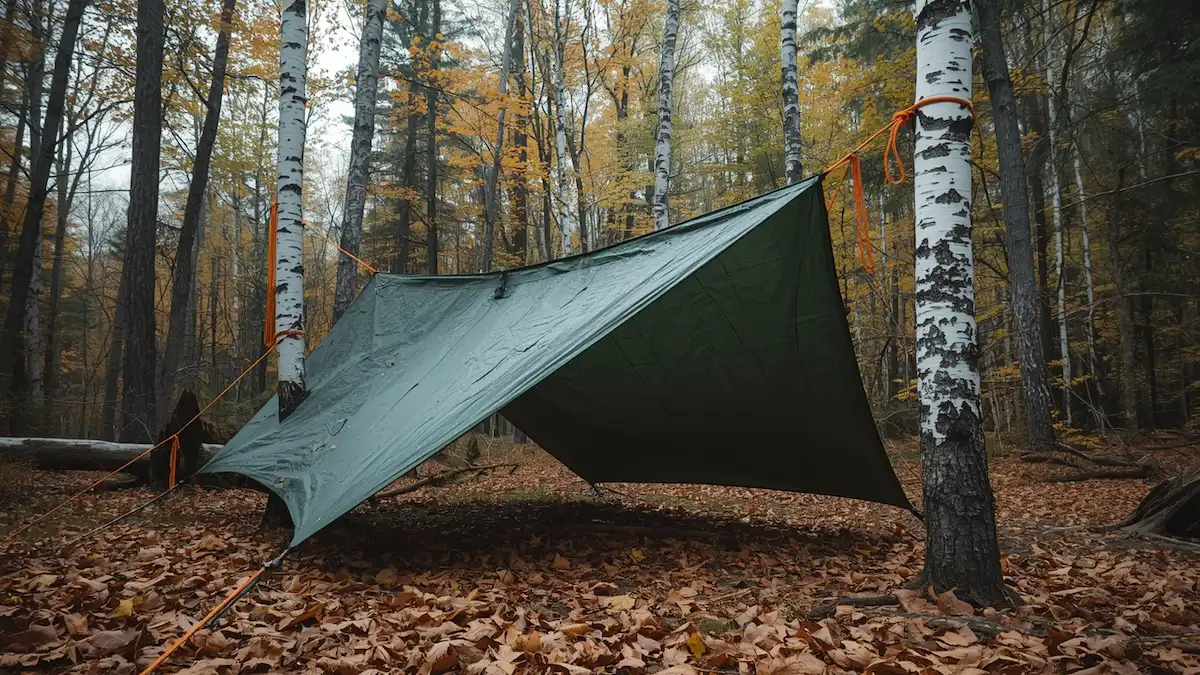
A tarp adjustments every little thing. What takes two hours with pure supplies takes ten minutes with a top quality tarp and 50 toes of paracord. In an actual emergency the place time and power are vital, the tarp is the right instrument.
Three configurations cowl the commonest survival eventualities. Study all three — every has completely different trade-offs on climate safety, pace, and materials necessities.
A high quality tarp is the one most useful piece of survival package you possibly can carry. Waterproof, light-weight, and deployable in a number of configurations with nothing however paracord and some stakes.
Test Value on Amazon
⚡ Tarp Wing — Quickest Setup
Setup time: 5 minutes | Finest for: Rain, fast camp, delicate wind
Run a ridgeline of paracord between two timber at shoulder top. Drape the tarp over the road and stake the 4 corners out at a low angle — two corners excessive on the ridgeline, two staked to the bottom at 45°. Creates a big coated space quick with minimal fuss.
Commerce-off: Restricted wind safety on the open sides. Good for rain, not full storm situations.
🔺 Wedge Tarp — Finest All-Circumstances
Setup time: 8–10 minutes | Finest for: Rain + wind mixed
Tie the ridgeline low — about 3 toes off the bottom. Stake one lengthy fringe of the tarp tight to the bottom on the windward aspect. The remaining sides type a wedge form that sheds rain and deflects wind concurrently. Low profile in excessive wind.
Commerce-off: Cramped inside area. Not supreme if you’ll want to sit up inside.
🏕️ Tarp Tipi — Finest for Chilly
Setup time: 10–quarter-hour | Finest for: Chilly nights, small campfire inside
A single central pole props the tarp right into a cone form. Stake the perimeter to the bottom and overlap the seam on the windward aspect. The cone permits a small fireplace within the heart with smoke venting by the highest hole. Wraps all the best way round for optimum wind safety.
Commerce-off: Requires a protracted heart pole. Smoke administration takes follow.
Each tarp configuration on this part requires paracord — for ridgelines, man strains, and lashing. 550 paracord holds 550 lbs, resists UV and moisture, and might be unraveled for finer cordage in a pinch. Essentially the most versatile survival instrument per ounce in your pack.
Test Value on Amazon
Commonplace shelter ideas apply in each surroundings — however snow and desert require specialised builds that tackle situations abnormal shelters can’t deal with. Snow shelters use the surroundings itself as insulation. Desert shelters should block radiant warmth relatively than comprise physique heat.
❄️ Quinzhee — Finest Snow Shelter for Most Conditions
Construct time: 2–3 hours | Inside temp: Close to 32°F no matter outdoors temperature
Pile snow right into a mound not less than 6 toes excessive and 10 toes vast. Let it sinter (harden) for 90 minutes — this step can’t be skipped.
Push 12-inch sticks into the mound throughout as depth guides. Dig an entrance tunnel and hole out the inside till you hit the sticks — the shell stays at a constant 12-inch thickness. Inside temperature stabilizes close to freezing even in -30°F outdoors air.
⚠️ Air flow: Poke a air flow gap by the roof with a ski pole or department earlier than sleeping. CO₂ accumulates in sealed snow shelters. Test it stays open all through the night time.
❄️ Snow Trench — Quickest Chilly-Climate Possibility
Construct time: 20–half-hour | Finest for: Open terrain, emergency in a single day
Dig a trench simply vast sufficient to your physique and deep sufficient to get under the wind line. Cowl the highest with branches, skis, or a tarp and pile snow on prime for insulation weight. The ditch is quick, requires no sintering time, and will get you out of wind instantly.
Commerce-off: Restricted area, low thermal mass in comparison with a Quinzhee. Finest used when time is brief and situations are determined.
🌵 Double-Roof Desert Tarp — Finest Desert Shelter
Construct time: 15–20 minutes | Finest for: Intense radiant warmth, direct solar publicity
In desert environments, the enemy isn’t chilly — it’s radiant warmth from the solar. A single tarp layer absorbs and radiates warmth inward. The answer is an air hole. Rig a primary tarp layer 12–18 inches above a second layer, making a dead-air insulation buffer between them. The outer layer absorbs photo voltaic radiation. The air hole dissipates the warmth earlier than it reaches the interior layer the place you shelter.
Orient the open sides to catch prevailing breeze. Shade is as vital as shelter in desert survival — search pure shade from rock overhangs, canyon partitions, or vegetation first earlier than constructing.
Important: Dig down 6 inches into the sand if doable — floor temperature 6 inches under the floor is considerably cooler than the floor itself.
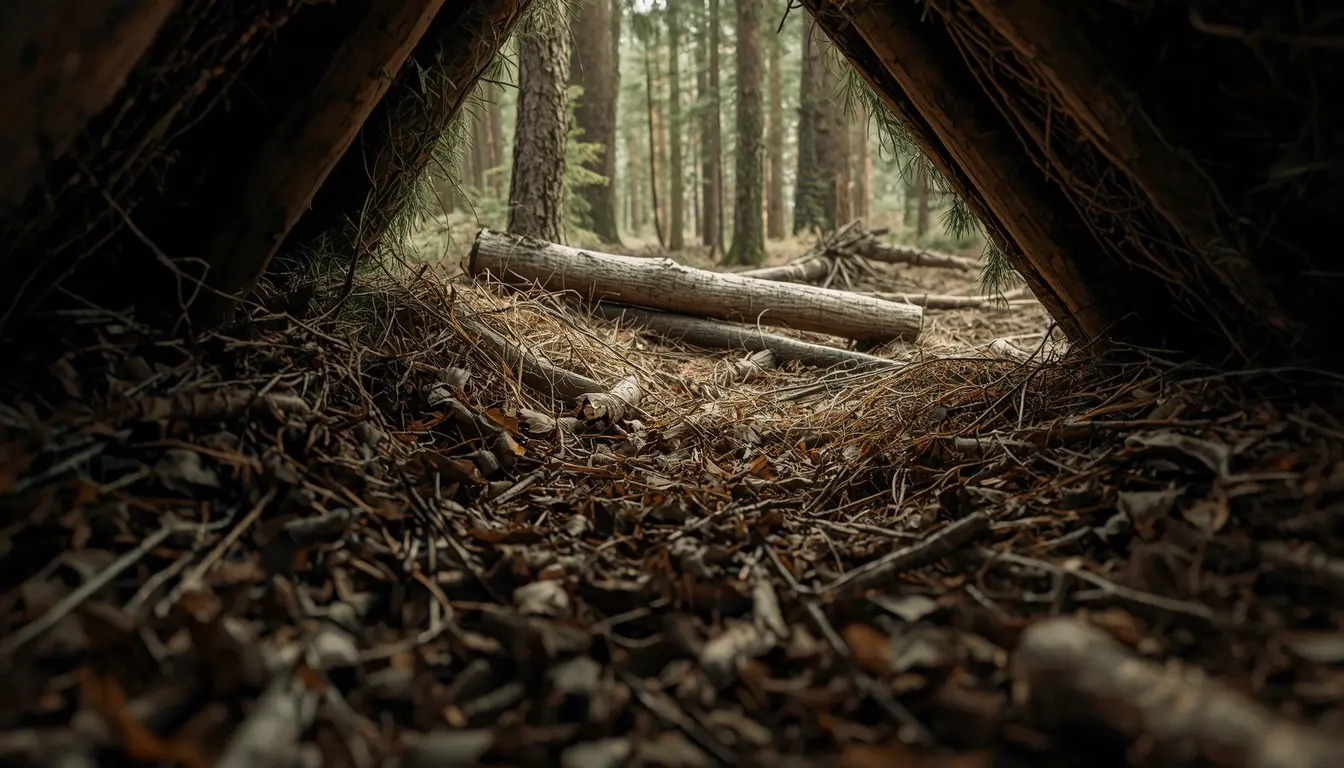
Most survival guides spend 90% of their time on the roof and 10% on the ground. That’s backwards. The bottom will kill you quicker than the sky will.
Conductive warmth loss — warmth transferring instantly out of your heat physique into chilly floor — is way extra environment friendly than convective warmth loss from wind.
Chilly floor at 40°F in touch together with your physique at 98.6°F conducts warmth away 25 occasions sooner than nonetheless air on the identical temperature. Each minute you lie on uninsulated floor, your core temperature drops sooner than when you had been sitting within the open air.
The particles mattress isn’t elective. It’s structural survival infrastructure.
Construct it earlier than you’ll want to sleep. Pile dry leaves, pine needles, cattail fluff, dry grass, or forest duff to a depth of not less than 6 inches — 8 to 10 inches is healthier. Compress it below your weight and it’ll compact to roughly half that depth, which continues to be satisfactory.
Floor Insulation — Materials Rating (Finest to Worst)
🥇 Dry cattail fluff — highest loft and thermal retention of any pure materials
🥈 Dry leaves (oak, maple) — ample, efficient, straightforward to gather in quantity
🥉 Pine boughs — good insulation, provides perfume, available in Northern Michigan
4th Dry grass — efficient however compresses shortly; pack thicker than you assume needed
❌ Moist or damp materials — conducts warmth away out of your physique; worse than nothing in chilly situations
When pure insulation isn’t accessible or situations are too moist to gather dry particles — a top quality emergency bivvy solves the issue immediately.
Mylar development displays as much as 90% of your physique warmth again inward. Waterproof, windproof, and packs to the dimensions of a fist. The insurance coverage coverage for any backcountry in a single day — pairs with any shelter on this information to get rid of conductive and convective warmth loss concurrently.
Test Value on Amazon
Thermal mass upkeep: in case your shelter flooring compresses through the night time, you’ll really feel the chilly floor by it.
Add extra particles earlier than you fall asleep — not after you get up chilly. Rebuilding physique warmth from a chilly core is way tougher than stopping the warmth loss within the first place.
Additionally, you will want dependable hands-free lighting whereas constructing and sustaining your shelter after darkish. Our greatest rechargeable headlamps for tenting and backcountry use covers the lighting choices we’ve examined in Northern Michigan discipline situations.
The worst time to construct your first survival shelter is the night time you really need one.
Construct a particles hut in your yard this weekend. Time your self on a lean-to at your subsequent tenting journey. Run a tarp wedge configuration within the rain to be taught the place the drips come from earlier than your life depends upon it.
Each shelter sort on this information has a ability curve. The lean-to feels apparent till you attempt to hold rain out of it. The particles hut feels simple till you understand how a lot leaf quantity you really need.
Wilderness First Help certification teaches shelter principle alongside wound administration and affected person evaluation for good cause — the abilities compound. Our 20+ years of discipline testing in Manistee Nationwide Forest began precisely this manner: constructing shelters we didn’t want in situations we may stroll away from, so the strategies had been automated when situations modified.
Follow in low stakes. Carry out in excessive stakes.
When your in a single day package extends past emergency shelter right into a base camp setup, our off-grid solar energy setup information for distant deployments covers the facility layer for prolonged stays.
Our prime moveable energy stations for tenting and backcountry use covers the battery choices that hold lights, communicators, and gadgets operating by a multi-night wilderness keep.
🎯 OTL Gear Picks — 4 Gadgets Each Survival Shelter Wants
Each primitive shelter on this information is improved by not less than one in every of these 4 objects.
Collectively they cowl each shelter state of affairs — pure construct, tarp configuration, snow and desert excessive, and floor insulation. All verified Amazon listings together with your Associates tag.
Merchandise
Finest Used For
The place It Matches in This Information
Hyperlink
Heavy Responsibility Survival Tarp
Tarp Wing, Wedge, Tipi configurations
Part 04 — all three tarp builds
Test Value
TECEUM 550 Paracord
Ridgelines, lashing, man strains, emergency cordage
Sections 03, 04 — each construct requiring cordage
Test Value
GROWIT Folding Noticed
Ridge poles, framework branches, particles hut backbone
Sections 03, 05 — any construct requiring lower poles
Test Value
Zmoon Emergency Bivvy
Floor insulation, reflective warmth retention, emergency backup
Part 06 — floor insulation and thermal mass
Test Value
The instrument that’s at all times lacking whenever you want it most. Triple-cut SK5 blade with 7 TPI enamel handles ridge poles, framework branches, and particles hut spines. Folds to pocket dimension, weighs subsequent to nothing. A folding noticed does in 30 seconds what a knife takes 10 minutes to perform.
Test Value on Amazon
Survival Shelter FAQ
What’s the best survival shelter to construct?
The lean-to is the simplest survival shelter to construct. It requires solely a horizontal ridge pole lashed between two timber, angled branches leaned in opposition to it, and a layer of particles for climate resistance.
Construct time is 20–half-hour with no instruments. The trade-off is thermal effectivity — a lean-to is an open-front construction that depends on a hearth in entrance of it for warmth. In delicate situations or when fireplace is feasible, it’s the proper alternative. In chilly and moist situations with no fireplace, a particles hut supplies much better thermal safety.
If in case you have a tarp in your pack, a tarp wing configuration is quicker than any primitive construct — rigged in below 10 minutes with paracord between two timber.
How do you keep heat in a survival shelter?
Staying heat in a survival shelter requires addressing each forms of warmth loss: convective (wind and air motion) and conductive (floor contact).
Most individuals focus totally on the roof and partitions — the convective layer — and neglect the ground. Chilly floor at 40°F conducts warmth away out of your physique 25 occasions sooner than nonetheless air on the identical temperature. A particles mattress of dry leaves or pine boughs not less than 6 inches deep is as vital because the roof above you.
Further ideas: hold the shelter small so your physique warmth warms the inside; shut the doorway with particles or a pack; put on a hat (30–40% of physique warmth is misplaced by an uncovered head); keep dry — moist clothes loses 90% of its insulating worth.
An emergency mylar bivvy provides a further layer of radiant warmth retention inside any shelter and is the most effective single addition to cold-weather survival package.
Is a snow cave protected?
A snow shelter — particularly a Quinzhee or snow trench — is protected when constructed accurately. The inside temperature of a correctly constructed snow shelter stabilizes close to 32°F no matter outdoors temperatures, which might be 50–60°F hotter than ambient air in excessive chilly environments.
The first hazard is CO₂ accumulation. A sealed snow shelter is an hermetic surroundings. As you breathe, CO₂ builds up and oxygen depletes. This isn’t a theoretical danger — it has induced fatalities in in any other case well-built snow shelters.
The repair is easy: poke a air flow gap by the roof with a ski pole, department, or trekking pole earlier than sleeping. Test all through the night time that it has not sealed with ice. Mark it with a department or pole so you’ll find it if the shelter drifts over.
The second hazard is collapse. A Quinzhee have to be allowed to sinter (harden) for 90 minutes earlier than hollowing — skipping this step dangers collapse throughout excavation. Use the stick-depth guides described in Part 05 to keep up constant 12-inch wall thickness all through.
How a lot paracord do I would like for a survival shelter?
For a fundamental tarp shelter, 50 toes of paracord is the minimal — sufficient for a ridgeline, two man strains, and fundamental staking. For a extra advanced setup with a number of anchor factors and a full perimeter stake-out, 100 toes is extra snug.
For primitive shelter lashing — securing a ridge pole, binding the Wicki-up apex, or lashing framework branches — shorter lengths work wonderful. The interior strands of 550 paracord (the 7 inside threads) might be separated for finer lashing work with out slicing into your predominant cordage provide.
Normal rule: carry not less than 100 toes of 550 paracord on any backcountry outing. It weighs below 7 ounces and has extra makes use of than nearly every other piece of package — shelter, gear restore, improvised animal snares, clothesline, emergency tourniquet wrap, and extra.
What’s the greatest survival shelter for chilly climate in Northern Michigan?
For chilly climate survival in Northern Michigan’s Manistee Nationwide Forest, Pere Marquette River hall, and Nordhouse Dunes terrain, the particles hut is essentially the most thermally efficient primitive shelter when you’ve got time and power to construct it.
The particles hut makes use of the mass of dry leaves surrounding your physique as insulation — successfully a sleeping bag manufactured from forest materials. Constructed accurately with 2+ toes of particles on all sides and a totally stuffed inside, it might probably preserve livable temperatures in near-freezing situations with no fireplace and no sleeping bag.
If in case you have a tarp, the tarp tipi configuration with a small fireplace inside is quicker and almost as efficient. Mixed with a mylar emergency bivvy for floor insulation, a tarp tipi with fireplace is essentially the most sensible cold-weather setup for many Northern Michigan emergency eventualities.
In winter with snow on the bottom, a Quinzhee is the warmest possibility accessible — however requires 2–3 hours of construct time and a 90-minute sintering wait earlier than hollowing.
Ought to I construct a hearth inside my survival shelter?
Generally, no. Constructing a hearth inside a pure particles shelter dangers setting the construction on fireplace — dry leaves and branches are extremely flammable. The lean-to is the exception: it’s an open-front design the place a hearth in entrance of the opening is a part of the supposed design, not contained in the shelter itself.
The tarp tipi is designed to accommodate a really small fireplace on the heart with a smoke hole on the prime — however this requires a dust flooring, cautious fireplace administration, and fixed monitoring. It isn’t a newbie method.
Snow shelters (Quinzhee, snow cave) can accommodate a small candle or tea gentle for supplemental heat — the snow partitions is not going to burn. Don’t use open flame inside a Quinzhee with out confirmed air flow.
The higher strategy for many survival conditions is: construct essentially the most thermally environment friendly shelter you possibly can, maximize floor insulation, and use physique warmth relatively than fireplace to heat the inside. Hearth is greatest used outdoors the shelter for heat, water purification, and signaling.
Store the OTL Survival Shelter Gear Picks
All hyperlinks go to verified Amazon listings. Test present pricing earlier than buying.
📚 Trusted Sources: Wilderness Survival and Backcountry Security
🌲 USDA Forest Service — Huron-Manistee Nationwide Forests
Official steering on backcountry use, tenting rules, and seasonal restrictions for Manistee and Huron Nationwide Forest land. Verify present guidelines earlier than any primitive tenting or backcountry in a single day within the forest.
Go to fs.usda.gov/huron-manistee →
🏕️ Prepared.gov — Emergency Preparedness and Survival Planning
Official FEMA emergency preparedness steering protecting shelter priorities, hypothermia prevention, excessive climate survival, and emergency signaling. The federal authorities’s main useful resource for wilderness and out of doors emergency planning.
Go to prepared.gov →
Area-tested out of doors tech from Ludington, Michigan.
Up to date Could 2026 · Out of doors Tech Lab


