

First launched 19 years in the past, Six Moon Designs’ Gatewood Cape is a combo rain cape, pack cowl, and floorless shelter that is available in at simply 11 ounces. How does it stack up in 2025?
The hood within the Gatewood Cape makes for a useful vent. (Photograph: James Stout)
Revealed December 6, 2025 05:03AM
Most of us know somebody who has gone too ultralight. Maybe they skimped on rain gear and obtained soaked, or they determined to avoid wasting a number of grams by choosing a warmer-weather sleep system and spent all evening wishing they hadn’t. On the opposite facet, all of us have packed too closely and suffered the implications: sore shoulders, burning legs, and a definite disinclination to sections of the path the place the contour traces stack up. For greater than 20 years, each change I made to my backpacking package was an effort to discover a comfortable medium between these two extremes, however after years of attempting each new factor that promised to avoid wasting a number of grams or present extra consolation, I discovered what I favored and settled down with a fairly dialed-in arrange.
Then, I began path working extra. As my journeys obtained longer and longer, I started to assume it could be good to take a minimalist sleep arrange and camp out, then run again within the morning. As a result of I’m in my late 30s and my knees damage, I made a decision to lurch towards the ultralight finish of the gear spectrum for this journey.
That’s once I got here throughout the Gatewood Cape from Six Moon Designs. Initially launched in 2006, it’s not precisely a brand new design. But it surely does do two issues that I very a lot recognize. It combines three items of substances in a single (shelter, raincoat, and pack cowl), and at 11 ounces, it weighs little or no. That’s a win on paper. However after all, even the lightest-weight gear is just definitely worth the grams if it might probably carry out on the path.
As most individuals who’ve served within the army know, sleeping below a poncho is just not a brand new concept. I’ve spent greater than my fair proportion of nights in what are variously referred to as “bashas,” “hoochies,” and even “ranger diamonds.” These are all primarily the identical factor: a poncho rigged as much as present overhead cowl within the rain. Most of my nights below one have been OK, although some have been depressing. (As soon as, in highschool, a pal arrange our shared poncho shelter in a ditch throughout a rainstorm. That is nonetheless the closest I’ve ever come to being waterboarded.)
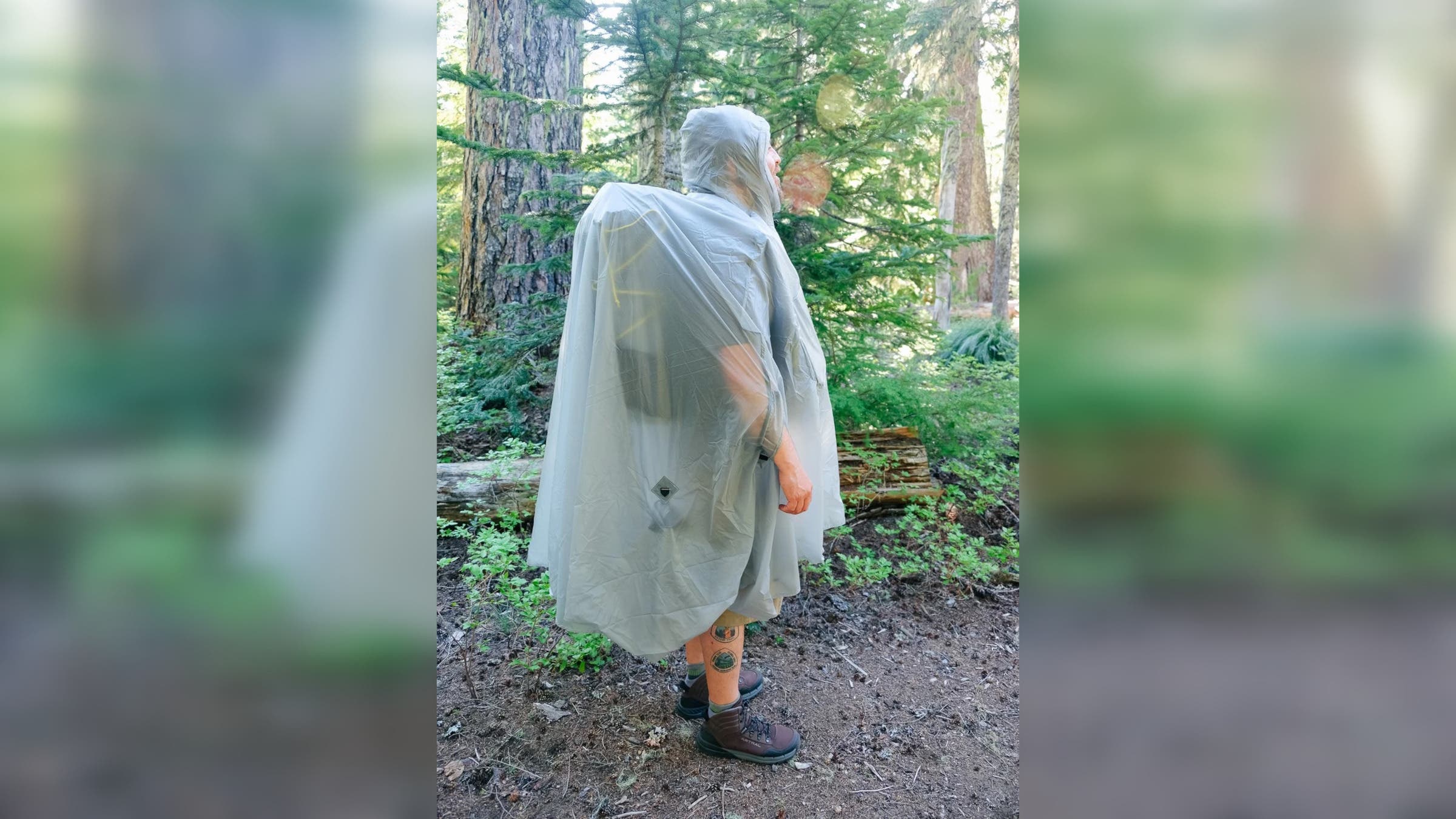
The Gatewood Cape, nonetheless, provides some important benefits over your run-of-the-mill poncho. The neck opening has a intelligent buckle harness that accepts the deal with of a trekking pole to function the principle structural assist of the shelter. This can be a important profit in comparison with utilizing bushes to safe your poncho as a result of not all over the place has bushes. The Gatewood additionally has a zippered opening, which lets you arrange the cape completely flush with the bottom on all sides and nonetheless get out and in. The stash pocket is a good place to maintain your headlamp and different nighttime necessities. If you would like, it’s also possible to purchase a bug internet from Six Moon that serves as an inside tent contained in the Gatewood. Due to its silnylon building, it additionally has the benefit of not being extremely loud and crinkly, which is one thing that I’ve come to detest about ultralight Dyneema shelters.
With the Gatewood Cape arrange in shelter mode, you’re going to be sleeping instantly on the bottom, and if that’s not one thing you or your ultralight pad can deal with, you would possibly want a groundsheet. Within the curiosity of being stupidly ultralight, I used a Gossamer Gear Thinlight pad, a chunk of Tyvek I had left over from some building, and a Sea to Summit sleeping bag liner. All advised, my total sleep, shelter, and rain-layering system weighed lower than a kilo.
My super-minimal sleep arrange labored tremendous for a fast run round Catalina Island close to my residence in Southern California, although I wouldn’t advise it for colder climate. The Gatewood Cape itself, nonetheless, is greater than able to standing as much as rain and even snow. In actually horrible climate, you would theoretically sleep within the tent, get up, poke your head by the neck gap and bask within the awe of the remainder of the campground as you stood up, carrying your tent as a raincoat. (I received’t deny that I did the “shelter to raincoat” factor a number of occasions, however that was principally simply me being a clown and ambushing my buddies.)
When I’ve used the Gatewood Cape in foul climate, it’s carried out in addition to a extra conventional floorless shelter. As with all tarp or poncho shelter, the standard of your expertise goes to be decided by the standard of your pitch. However the Gatewood has loads of guylines, and a line lock to regulate stress on them, and the mountaineering pole cradle is far simpler to arrange than a ridgeline for a tarp could be. This makes the setup easy in comparison with a typical poncho shelter and with a number of tries, anybody ought to be capable to get pitch. House below the shelter can be decided by pitch top; I’m 6’3”, and I had no points becoming myself and the pack I used as a pillow below the tarp. These with extra gear would possibly discover it exhausting to get all the pieces coated, however this type of setup may be very a lot designed with the minimalist in thoughts.
Technically, the Gatewood is a cape, not a poncho, as a result of it doesn’t have slits within the sides like a poncho does. This makes it a slightly higher rain coat than a poncho whereas nonetheless masking your pack and physique like a poncho does. (It could be too massive for some our bodies and drag on the bottom, however that wasn’t a problem for me.) The Gatewood, nonetheless, additionally shares a few of the downsides of ponchos, akin to flapping round in excessive wind like a kind of inflatable dancing males they put exterior used automotive dealerships.
You possibly can mitigate a few of the flappage by placing your pack over the cape and utilizing the waist straps and shoulder straps of your pack to maintain the cape tighter to your physique, with the apparent tradeoff that the cape will then fail to maintain your pack dry. Some of us appear to have the ability to use the guylines as a belt, however I by no means obtained that down. It additionally doesn’t have sleeves, simply arm holes, and this implies your forearms would possibly get moist. In a sustained downpour, I additionally count on that the thinner silnylon of the cape may moist out. By myself desert journeys, the Gatewood did job of retaining me dry in occasional showers and even being fast sufficient to pitch that I may make a littler shade shelter once I stopped for lunch.
These are compromises, to make certain. However I’ve rain jackets that weigh twice as a lot because the Gatewood, and I can’t sleep below them. I’ve tents that weigh three to 4 occasions as a lot, and I can’t put on them. Carrying 7 or 8 kilos of extra stuff can be a compromise. At a weight lighter than a can of beer, the Gatewood is barely noticeable in my pack. It may not be probably the most luxurious shelter, however it helped me transfer by the hills quicker and with much less ache. For me, that’s a win.


