

Article at a look: Chilly climate Mylar baggage (often known as bivvy or bivy baggage) are ultralight emergency shelters constructed from heat-reflective polyester movie designed to retain radiant physique warmth. Whereas they mirror radiant emissions, they incessantly fail as a sub-zero emergency sleeping system as a result of they lack conductive insulation and lure inner moisture. Addressing these failures requires transitioning from non-porous Mylar to extra environment friendly alternate options that may handle the important moisture-retention hole.
Are “Chilly Climate Mylar Baggage” a Survival Delusion?
A Mylar emergency bag is a specialised heat-reflective shelter designed to stop hypothermia by bouncing radiant warmth again to your physique. Nevertheless, advertising tags labeled “Chilly Climate Rated” are sometimes deceptive in sub-zero environments. With no complete system, these baggage result in moisture entrapment and fast conductive warmth loss.
Go to Amazon or any survival website, and also you’ll see the “Chilly Climate Rated” tag slapped on $15 silver bivvies. Based mostly on years of field-testing in high-alpine and concrete collapse situations, I can inform you that this advertising is harmful. Counting on these as a standalone sleeping system in sub-zero temperatures isn’t preparedness; it’s a bet that may result in critical harm or dying.
Why does conduction trigger Mylar bag conduction failure?
Warmth reflection is simply one-third of the survival equation. In case you lie on 20°F frozen earth, you lose warmth by conduction sooner than the Mylar can mirror it. With no bodily insulator, the fabric compresses to paper-thinness and transforms right into a thermal bridge reasonably than a barrier.
Whereas Mylar does mirror 90% of your radiant warmth, it’s biologically ineffective should you do not account for the bottom beneath you. With no pad or particles, the Mylar turns into a shiny wrapper for a frozen physique. To cease conductive warmth loss, you could set up a useless air house between your physique and the soil.
What’s the 4-inch rule winter survival protocol?
The 4-inch rule is the necessary survival customary for making a conductive barrier within the discipline. It dictates that you could place no less than 4 inches of compacted, dry particles, comparable to pine boughs, leaves, or dry grass, between your Mylar bag and the bottom. This creates the useless air house that Mylar lacks, successfully stopping the earth from siphoning your core temperature.
In case you’re transferring and lacking a foam sleeping pad, this rule is your solely protection towards the frozen earth. Mylar has zero loft so it received’t defend you from the bottom. The 4-inch particles mattress gives the R-value required to make the reflective properties of the bag really work.
How do you stop emergency bivy condensation?
Normal Mylar is a non-porous vapor barrier that creates a harmful condensation lure generally known as the “Trash Bag Impact.” Your physique’s moisture soaks your clothes and base layers. In sub-zero temperatures, this moisture freezes the second you exit the bag, turning your important layers into stable blocks of ice.
The answer requires sustaining a “Face-Out” vent or using breathable supplies like metalized olefins. Managing inner humidity is a non-negotiable requirement for stopping a flash-freeze of your base layers.
Normal Mylar vs. Breathable Metalized Olefin
To resolve the moisture lure, survival expertise has developed from non-porous polyester to breathable metalized olefins. These materials permit gas-state moisture to vent by microscopic pores whereas nonetheless reflecting radiant warmth. This transition is important for anybody transferring from emergency survival to sustained cold-weather endurance.
When selecting gear, you’re not simply searching for “shiny.” You’re searching for a fabric that manages the delta between your physique warmth and the exterior surroundings. Non-breathable foil is a brief repair, whereas breathable membranes are a sustainable system.

picture from Amazon
Specs: 90% warmth reflective; 3.8 oz weight; 100% waterproof Heatsheets® materials.
Greatest for: Ultralight Bug-Out Baggage (BOB) the place each ounce counts.
The Professional View: Excessive-visibility orange ensures you might be discovered if stranded, whereas the sealed seams stop wind-chill penetration.
(As an Amazon Affiliate, we earn from qualifying purchases.)
Steadily Requested Questions
Are you able to sleep in chilly climate Mylar baggage throughout winter? Provided that used as a element in a bigger system. With no floor pad or the 4-inch rule and moisture administration, you danger flash-freezing from your individual sweat and conductive warmth loss to the frozen earth.
How a lot heat does a sub-zero emergency sleeping system add? A typical Mylar blanket provides roughly 8-10°F of radiant warmth reflection however presents 0°F of conductive insulation. It’s acquired to be paired with no less than 4 inches of lofted particles to be efficient on frozen floor.
Why is the 4-inch rule important for winter survival? Mylar is a radiant barrier, not an insulator. As a result of it’s paper-thin, it doesn’t defend towards conduction. 4 inches of particles is the minimal depth required to create an air hole that stops the bottom from absorbing your physique warmth, significantly in Mylar programs the place no different insulation exists.
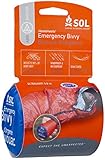
S.O.L. 90% Reflective Light-weight Emergency Bivvy
Final replace on 2026-02-20 / Affiliate hyperlinks / Photographs from Amazon Product Promoting API


