

When you’ve by no means been to the Wallowa Mountains, you’ll be stunned by what you discover there: an alpine wonderland rising unexpectedly from the sage-covered hills of northeastern Oregon. Backpacking within the Wallowas, and in Eagle Cap Wilderness extra particularly, gives huge mountain surroundings rivaling components of the excessive Sierra, however at a smaller scale and with out the allow hassles.
You could possibly wander the Wallowas for per week linking up numerous trails into loops or traverses. Most guests backpack the considerably simpler Lakes Basin Loop in the most well-liked and accessible area south of Joseph, however this publish is NOT about that loop. I’m allergic to the trail most traveled, and as a substitute selected a difficult 36 mile loop ranging from the southern fringe of the Eagle Cap Wilderness.
This route dips into the highlights of the Lakes Basin space on the north, together with an non-compulsory Eagle Cap summit, however approaches and returns by way of extra rugged and less-traveled trails of the southern area. When you like solitude blended with huge climbs and descents on trails that aren’t completely manicured, that is the route for you.
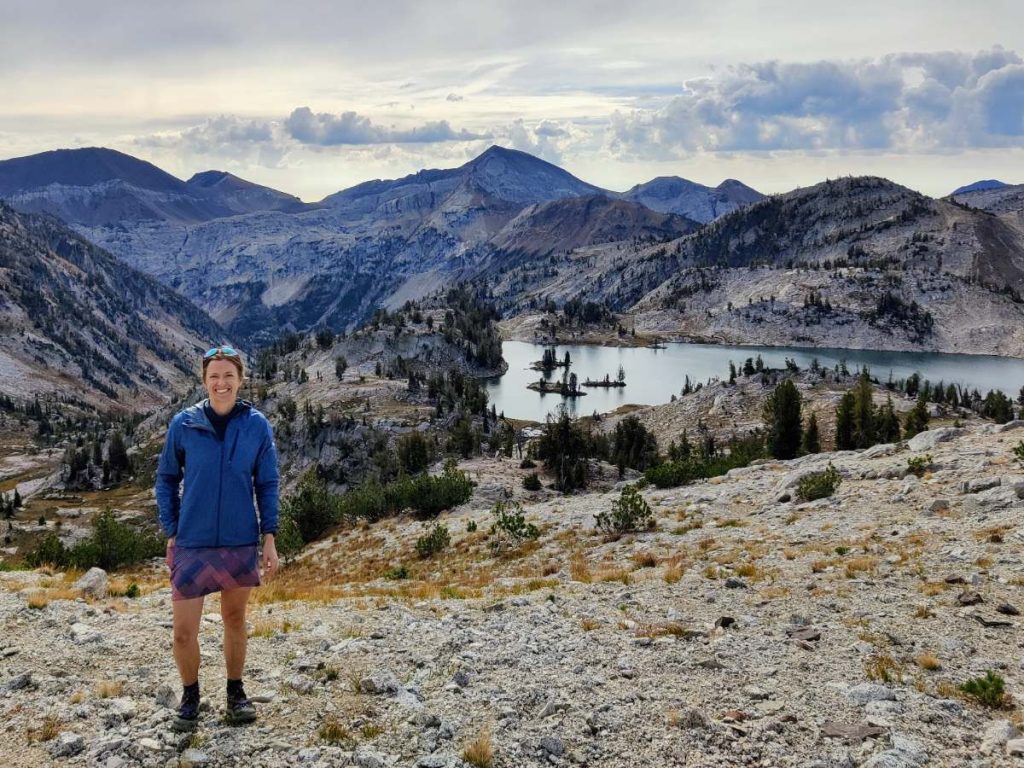
I backpacked this Eagle Cap Wilderness loop with my accomplice over 3.5 days in mid-September of 2023. We had largely glorious climate and located the paths to be in higher situation than anticipated (upkeep stage varies 12 months to 12 months). Primarily based on our expertise, I extremely advocate it, however I virtually hesitate to take action. I don’t need this stunning space, rightly nicknamed the Alps of Oregon, to turn out to be a sufferer of its personal recognition. When you do go backpacking in Eagle Cap Wilderness and the Wallowas, please tread frivolously and Depart No Hint as all the time — let’s preserve this particular place pristine.
If you purchase by means of affiliate hyperlinks on this publish, I’ll earn a small fee. Thanks in your help! I all the time supply unbiased opinions based mostly on actual expertise from the highway and path. Study extra.
At A Look
Location: Wallowa Mountains, northeastern Oregon
Distance: 36 miles
Days: 3 – 5 for many hikers
Elevation acquire / loss: 9200 toes
Min and max elevation: 4565 to 9550 toes
Season: July – September
Issue: onerous
Path information and circumstances: USFS web site and AllTrails
Highlights:
Pretty alpine surroundings, together with Lakes Basin highlightsExplore rugged and less-visited trails in Eagle Cap WildernessAbundant water sourcesConvenient loop logisticsNot too crowdedNo allow quota (free self-issued allow at trailhead)
Lowlights / potential challenges
Some trails not lately maintained, count on blowdowns and encroaching brushTrailhead requires driving 23 miles on gravel highway (2wd low clearance okay, however go gradual).
Who will love this route: Skilled backpackers who love solitude, lengthy climbs and descents, and trails that aren’t overly manicured
Who would possibly wish to skip it: New or unconfident backpackers, those that aren’t up for lengthy climbs and descents (first climb is 5000 toes!), those that aren’t comfy driving for an hour+ on gravel forest roads
Bikes: not allowed
Map and Navigation
Right here is the AllTrails map of our actual route:
To navigate we used the AllTrails app with premium subscription that enables caching maps for offline use, which is nicely definitely worth the few {dollars} a month. Since there have been two of us, we every served as one another’s navigation backup (two telephones with two offline maps) and didn’t carry a paper map.
When you’re solo I’d advocate a backup paper map (the Inexperienced Trails map is a well-liked selection) at minimal, and maybe a backup telephone or GPS system with the route downloaded. Some junctions are well-signed, however there’s all the time a risk of shedding the path. You’ll be able to’t rely on assembly different hikers to ask for instructions on the less-traveled components of this loop.
We bought our route inspiration from this journey on Climbing Venture (consists of further out and again to Hidden Lake) and this AllTrails route (omits out and again to Eagle Cap summit), and made only a few of our personal modifications. Specifically we skipped the out and again to Hidden Lake on the primary evening, as there have been loads of spots to camp immediately on East Eagle Path. We additionally took a extra direct method to Eagle Cap summit that makes extra sense when touring clockwise.
Entry Trailhead
Whereas most hikers enter the Wallowas from the extra accessible northern trailheads, like Little Alps Trailhead south of the city of Joseph, this route begins on the southern fringe of the wilderness at East Eagle Trailhead.
If coming from Baker Metropolis to the west, the best path to East Eagle TH requires driving 23 miles on gravel after you permit the pavement of Freeway 86. The highway is well-maintained if you happen to take the proper route (see under) and commonplace 2wd automobiles could make the journey, however it may be badly washboarded in locations and also you’ll have to go slowly.
IMPORTANT: The most effective route from Freeway 86 is probably going NOT the route that Google Maps suggests. About 10 miles from the pavement it’s best to take a proper flip to remain on well-maintained gravel by way of NF-7715 and NF-77. Going straight as a substitute on NF-7020 places you on a tough and slim filth highway that’s sketchy with out 4 wheel drive. That is the best method to drive to East Eagle Trailhead if coming from the west.
It’s additionally potential to achieve East Eagle Trailhead from Midway, OR additional to the east. I consider this can be a simple drive on gravel NF-77, however haven’t pushed it myself.

Parking at East Eagle Trailhead is free, and there are many free dispersed tenting spots within the space if you wish to spend an evening earlier than or after your hike. As you close to the top of the highway you’ll see a car parking zone on the suitable that claims trailer parking. Park right here you probably have a bigger car or need extra solar for photo voltaic panels, and take the Kettle Valley Path or stroll alongside the highway (provides roughly a mile to the hike). In any other case proceed to the car parking zone on the very finish of the highway, which is the place this loop begins.

When to Hike
Backpacking within the Wallowas is a summer season exercise, as the upper trails are sometimes snow-free from July to September. Particulars differ from 12 months to 12 months based mostly on snowpack and climate. In a excessive snow 12 months there is perhaps snow within the excessive nation nicely into July, whereas on low snow years late June is perhaps possible. Test current path experiences on AllTrails and the USFS web site for the newest circumstances, preserving in thoughts that circumstances change from 12 months to 12 months.
Mosquitoes are a problem throughout early summer season whereas snow is melting and leaving swimming pools of standing water (convey bug repellent!). As soon as a lot of the snow has melted and standing water has dried (normally August) bugs are much less of a problem. On the intense aspect, wildflowers are normally at their greatest in July and early August.
September brings cooler temps, elevated probability of snow, and shorter sunlight hours, particularly towards the top of the month. Whereas September can typically be an ideal time to hike within the mountains (I hiked this route from Sept. 16 – 19 and had nice climate) be sure you examine the forecast and convey acceptable gear.
Days and Path
Most backpackers ought to plan 3 to five days to finish this loop. We spent 3 nights and 4 days mountain climbing this route, however our first and final have been half-days, so actually it was three days of mountain climbing for us. This was sufficient time to deal with shorter September sunlight hours and the truth that we weren’t in backpacking-specific form, however not a lot time as to really feel leisurely. I’d say the common backpacker, with some expertise and first rate health, can end this route in 4 full days particularly with longer summer season sunlight hours.
Take into account that virtually each mile is both uphill or downhill, some sections of path are rocky and gradual, and the excessive elevation will really feel taxing if you happen to’re not acclimated. Additionally, there are various attractive locations to camp or get pleasure from an extended lunch break. In different phrases, enable a bit of additional time!
Must you hike clockwise or counterclockwise? We selected clockwise as a result of the climb is usually a gentler grade and usually a nicer method to the beautiful excessive alpine area. The East Eagle Path follows a creek with water and periodic tenting alternatives, whereas the Kettle Creek Path is a steeper ascent up a brushy hillside; you’ll in all probability have to make it to Crater Lake earlier than tenting if you happen to go counterclockwise.
The one benefit I can see to going counterclockwise: the Kettle Creek Path appears to be much less continuously maintained than others, and experiences from a couple of years in the past described it as a troublesome bushwhack. We discovered it pretty nicely trimmed once we went by means of, however if you happen to fear about making it by means of this part, maybe higher to get it over with early when you nonetheless have the choice to show again.
Tenting
Tenting is straightforward on this route: merely search for a beforehand used flat space on a sturdy floor with out reside vegetation (filth, pine needles, and so forth). You’ll discover websites each few miles or extra on a lot of the route, typically properly tucked away within the bushes close to water sources. Websites are extra frequent within the gradual valleys and basins, and just about all of the lakes have a couple of campsites. On weekends the websites within the fashionable Lakes Basin space is perhaps crowded.
If you do camp, it’s clearly vital to observe Depart No Hint to maintain this pristine alpine wonderland in good condition. Listed here are the fundamentals:
Don’t camp or poop inside 100 toes of a water supply or wetlands (at a number of the lakes the established websites don’t observe this rule, during which case stroll nicely away from the water to make use of the toilet).Don’t wash garments or do dishes immediately in water sources.Bury poop in a cathole at the least 6” deep and pack out used bathroom paper (extra on this enjoyable topic right here).Observe all campfire restrictions famous in your allow or indicators.Observe all posted indicators about the place to camp and never camp, particularly across the fashionable lakes the place some areas are off-limits to let vegetation get better.

Recommended Itineraries
There are lots of good locations to camp on this route; simply be sure you select beforehand used websites on sturdy surfaces (i.e. not on high of dwelling vegetation). Just about each lake has some campsites close by, and also you’ll discover them tucked away each couple of miles in a lot of the valleys. The one locations with out campsites are normally the steep climbs to and from passes the place the path switchbacks throughout a steep hillside.
You don’t essentially have to plan each camp location upfront; in actual fact it’s extra enjoyable not too. However in your planning functions, listed here are some itineraries you would possibly purpose for relying in your goal tempo.
Our Itinerary (3.5 days 3 nights)
We based mostly this itinerary extra round the place we ended up and fewer round in search of out probably the most ideally suited camp spots. The most important downside was the lengthy third day, however the benefit was that we have been capable of drive out and in on the identical days we hiked. If in case you have time, I’d advocate driving within the day earlier than and tenting close to the trailhead, then getting an earlier begin on day 1.
Day 1: 5.5 miles to campsite by East Fork Eagle Creek (half day)Day 2: 9 miles to Moccasin Lake, together with out and again to Eagle Cap summitDay 3: 16 miles to Crater LakeDay 4: 5 miles to East Eagle Trailhead (half day)
Quick Itinerary (3 Days 2 Nights)
When you’re in form and touring gentle, you can knock this route out in three days with variations on this itinerary:
Day 1: 9 miles to hanging meadow earlier than ultimate climb to Horton Go (or, if climate is nice, proceed 1 extra mile to camp at high of Horton Go to make tomorrow shorter)Day 2: ~15 miles to someplace alongside South Fork Imnaha River (consists of Eagle Cap summit)Day 3: 12 miles to East Eagle Trailhead
Reasonable Itinerary (4 days 3 nights)
Day 1: 9 miles to hanging meadow earlier than ultimate climb to Horton PassDay 2: 8 miles to Glacier Lake (consists of Eagle Cap summit)Day 3: 13 miles to Crater LakeDay 4: 5 miles to East Eagle Trailhead (half day)
There are lots of good variations on this 4 day itinerary. You could possibly make the primary day somewhat shorter by tenting round mile 5 – 6 on the East Eagle Path, or taking the side-trail to Moon or Hidden Lakes. Then you can also make the second day shorter by tenting at Mirror or Moccasin Lake (each good, although Glacier is arguably extra scenic).
When you don’t make all of it the best way to Crater Lake on the third day, search for a spot alongside the South Fork Imnaha River earlier than beginning the climb to Crater Lake. This breaks up the mileage extra evenly, but in addition makes it more durable to drive out and get your burger and bathe on the finish of day 4.
Leisurely Itinerary (5 days 4 nights)
5 days is a snug itinerary for this route, particularly if you happen to’re carrying heavier gear and/or wish to spend some leisurely time at camp. Right here’s an instance:
Day 1: 5.5 miles to campsite by East Fork Eagle Creek (or take the aspect journey to Moon or Hidden Lake)Day 2: 9 miles to Moccasin Lake (consists of Eagle Cap summit) – may simply alter to be a bit shorter (Mirror Lake) or longer (Glacier Lake)Day 3: ~9 miles to website alongside South Fork Imnaha River (not actual location)Day 4: ~6 miles to Crater LakeDay 5: 5 miles to East Eagle Trailhead
Meals Storage
There are black bears within the Wallowa Mountains, however they don’t sometimes pose a hazard or problem to hikers. Nonetheless, it’s greatest to retailer your meals responsibly: both cling it correctly, use an Ursack (I feel a hard-sided canister is overkill right here) or sleep with it. I’d be a bit extra cautious on the closely used websites within the Lakes Basin, the place it’s potential a bear has realized to understand the style of hiker meals. We used an Ursack Main, merely tied to a powerful tree (the bushes in lots of areas weren’t appropriate for a superb bear cling).
Water
Water is considerable on this route. Even throughout our hike in late September we by no means wanted to hold greater than two liters at a time. Many of the lengthy climbs and descents observe flowing creeks, and the Lakes Basin part is, unsurprisingly, stuffed with lakes. The one part that is perhaps missing water (and even there we discovered a couple of streams) is the ultimate descent down Kettle Creek Path after leaving Crater Lake.

Make sure you filter or deal with your ingesting water to keep away from ailments like Giardia, which will be unfold by different hikers pooping within the woods. We used our traditional system: a Sawyer Squeeze filter and CNOC Vecto bag arrange as a gravity filter. For different choices, see Finest Water Filters for Backpacking.
I attempted a brand new water carrying system on this journey: the Smartwater Bottle drink tube from One Bottle Hydration. I’ve lengthy been a hydration bladder fan since I can’t attain bottles in my pack’s aspect pockets, however this technique is the perfect of each worlds and my new go-to. Study extra concerning the professionals and cons in 5 Methods to Carry Water Whereas Backpacking.
Permits
You do want a allow to hike this Eagle Cap Wilderness loop, however you’ll be able to self-issue it without cost on the East Eagle Trailhead. Merely fill out the data (there ought to be a pencil within the field) and drop the official copy within the slot, then learn the rules and preserve the customer copy with you whereas mountain climbing.
Notice that there are two parking tons within the space, and two trailheads. The primary says “trailer parking” and is definitely the trailhead for the Kettle Creek Path, alongside which you’ll hook up with the true begin of the loop at East Eagle. This trailhead could not have a allow station (I don’t keep in mind seeing one). The official East Eagle Trailhead, a bit additional on the very finish of the highway, positively has a allow station.
Path Description by Part
This description begins at East Eagle Trailhead and goes clockwise. Mile references are from the AllTrails map of the route we hiked.
East Eagle Trailhead to Horton Go
From East Eagle Trailhead going clockwise, you’re 10 miles and 4000 toes of climbing (plus an extra thousand toes if you happen to do the out and again to Eagle Cap). Don’t fear although, a lot of the climb is gradual because the path meanders alongside East Fork Eagle Creek. You’ll seemingly wish to break up this climb into two days and there are some campsites all through this part, particularly the place the valley broadens a bit. Keep away from websites closest to the creek if you happen to can, as a result of they are often chilly and damp in a single day.

At mile 6.5 there’s an non-compulsory out-and-back on the left to Moon Lake and Hidden Lake. This provides mileage and climbing however is an possibility for individuals who prioritize tenting at attractive lakes. When you prioritize avoiding out-and-backs, you will discover tenting on East Eagle Path.

Round mile 9 the path crosses a stream in a scenic excessive meadow, the final cheap tenting earlier than the move, and begins climbing extra steeply to Horton Go. Horton Go itself has a couple of campsites on the high, sheltered solely by scrubby bushes, however I’d not wish to camp up there in excessive wind or stormy climate.

This part of path just isn’t as well-travelled because the Lakes Basin space, and we noticed only a couple different hikers on it. Once we hiked this path we discovered it overgrown in locations and needed to hike round a couple of blowdowns, but it surely was simple sufficient to observe.
Eagle Cap Summit (Optionally available)
At Horton Go, ten miles in, there’s the choice to drop your pack and do a 1.5 mile out-and-back to Eagle Cap summit, a thousand vertical toes increased. I extremely advocate this, you probably have time. You’ll get unimaginable views of the valley you simply hiked up in addition to the Lakes Basin into which you’ll hike subsequent.

Most hikers ought to enable at the least two hours for this tour, possibly extra if you happen to’re feeling sluggish. Make sure you convey at the least a liter of water, a sack, a jacket for the wind, and mountain climbing poles you probably have them (and I like to recommend you do).
From Horton Go, look to the suitable and also you’ll see a faint rocky path. Don’t fear, it quickly will get a bit smoother and is straightforward to observe all the best way to the summit. Partway up this path joins with one other one which intersects your route a bit additional down en path to Mirror Lake, however from Horton Go it’s best to take the path you’re on.
Eagle Cap summit is a well-liked aspect journey for backpackers on the Lakes Basin Loop, so count on to see different hikers right here. When you drop your pack on the move be conscious of your meals provide and don’t go away snacks accessible to critters.


Hawkins Go to East Eagle Trailhead
This ultimate part is much less well-traveled than the remaining; once we backpacked this loop we noticed actually no different hikers from Frazier Lake to the top.
From Hawkins Go the path descends throughout a steep and typically unfastened hillside all the way down to a rugged alpine valley. I believed the views on this space have been particularly good! The highest is steep however the gradient eases because the path gently descends alongside the South Fork Imnaha River, contouring round Cusick Mountain to your left.


About 5 miles after leaving Frazier Go, the descent lastly ends at a junction with Cliff Creek Path (known as Cliff River Path on the indicators). Flip proper to transition into the Cliff Creek drainage, the place a largely gradual 5 mile climb to Crater Lake awaits. Although Cliff Creek / River surprisingly doesn’t present up on the AllTrails map, there’s certainly a roaring waterway right here. Entry just isn’t all the time simple because of the steep banks, however you can refill in a pair locations if wanted.

Campsites and flat spots are scarce on this part, although you might be able to discover a small one in a pinch. Normally I’d advocate making an attempt to complete this climb and camp at Crater Lake; we pushed onerous to get this performed on the finish of an extended day.
Crater Lake is rather more remote-feeling than the extra fashionable lakes of earlier within the loop – we had the complete place to ourselves. In mid-September the water stage was a bit low but it surely was nonetheless a fairly place. The most effective campsites are discovered the place the path wraps across the northern fringe of the lake. There are a couple of bushes for shelter and coziness, and straightforward water entry and nice views of the mountains throughout the water.

From Crater Lake, Kettle Creek Path plunges 3000 toes in 5 miles, largely by way of switchbacks throughout alternately scrubby and forested hillside excessive above Kettle Creek. It’s possible you’ll not discover any water on this part, so refill at Crater Lake. Studies from Climbing Venture indicated that this part was a irritating bushwhack, so we anxious about it beforehand. However somebody should have performed some pruning, as a result of we discovered it completely acceptable. Brush encroaches on the path in some locations, but it surely didn’t gradual us down.

Close to the underside you’ll attain a junction: head left if you happen to parked on the trailer car parking zone or proper for East Eagle Trailhead on the finish of the highway. Your loop is completed!
Backpacking Gear
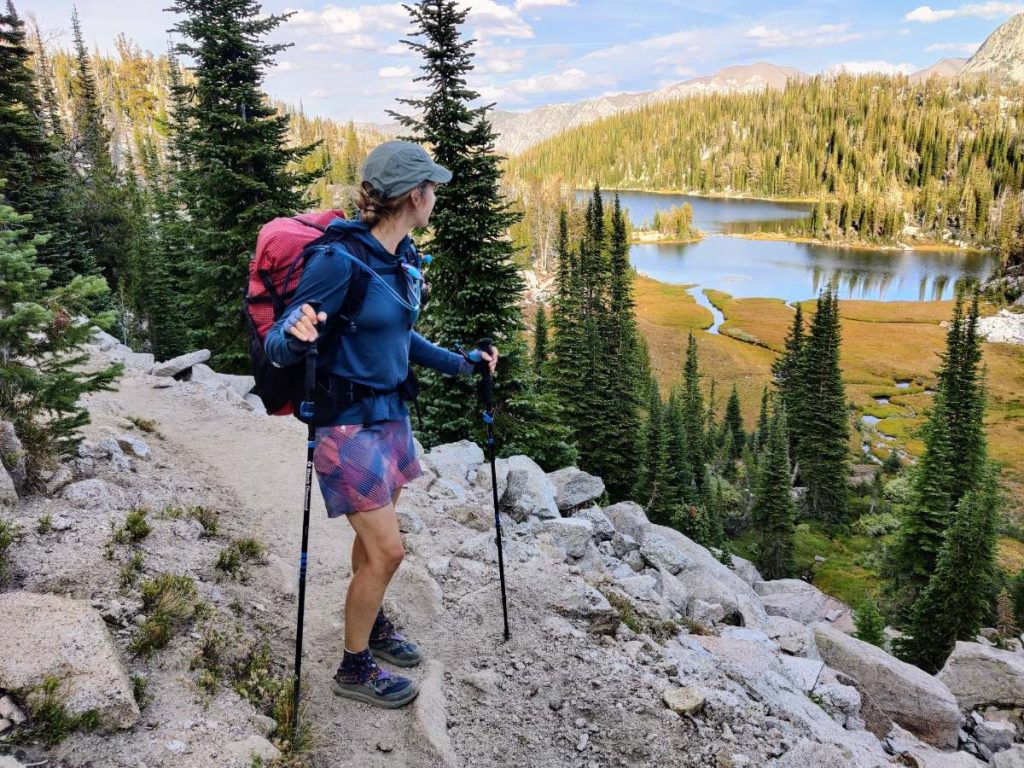
I all the time advocate a comparatively light-weight backpacking gear setup as a result of it’s extra comfy and enjoyable, and that is actually true on the lengthy climbs and descents of the Wallowas. Listed here are a number of the key gear objects I take advantage of on most backpacking journeys, and on this Eagle Cap Loop particularly. For extra, see my favourite backpacking gear.
Backpacks: We each carried ULA Circuits. We love them as a result of they’re light-weight, adjustable, and have a really versatile 68 liter capability. On this quick path we saved them cinched all the way down to a smaller quantity, however in addition they increase to handle 7-day meals carries when wanted.
Sleep: Therm-a-Relaxation NeoAir XLite sleeping pads (heat and lightweight) and Enlightened Tools Convert quilts with artificial hoods. The Convert is a superb center floor between a sleeping bag and a light-weight quilt as a result of the total zipper helps stop drafts in cooler temps.
Shelter: Borah Gear bivvies and a Six Moon Designs Haven tarp. We love this setup for backpacking as a pair as a result of we will arrange the bivvies alone on clear nights for a bit extra space and stargazing, or we will get cozy within the tarp when extra heat or climate safety is required. We solely pitched the tarp as soon as on this path when the sky threatened rain, and in any other case loved views of starry skies from our bivvies.
Footwear: Altra Lone Peak path trainers. We’ve each been mountain climbing and operating in these for a few years and gained’t put on anything. They’re cozy, breathable, quick-drying, and have glorious traction.
Cooking: JetBoil MicroMo, tremendous quick at boiling water for rehydrating meals. Snow Peaks titanium mugs for drinks (a luxurious merchandise), Sea to Summit collapsible X-Mugs as bowls, Toaks titanium long-handled spoons.
Water: Sawyer Squeeze filter in gravity mode with CNOC Vecto 3 liter soiled bag.
Electronics: Garmin InReach Mini, Petzl Actik headlamp, energy financial institution and cables
Different must-have objects:
Climbing poles for steadiness and efficiencySunscreen, hat, maybe arm sleeves or a solar hoodieRain gear and heat layersWarm gloves, helpful on chilly September mornings
Extra Assets
When you love backpacking, you may additionally like these different posts:
Or go to the backpacking dwelling web page for tons extra!

In regards to the Creator
Hello there, I’m Alissa, founding father of Exploring Wild. I’ve had the pleasure of mountain climbing the Arizona Path, Colorado Path, John Muir Path, Tahoe Rim Path, and numerous shorter superb trails all through the US and overseas. I like solitude, huge views, and a superb light-weight gear setup. Study extra right here.


